
Commercial Door Closer Adjustment in Atlanta
Door closer adjustment in Atlanta fixes slamming, slow and non-latching commercial doors by setting the sweep speed, latch speed, backcheck and spring power.
Direct line (470) 256-0441
- Atlanta only
- Call, no forms
- Cites the 2010 ADA Standards and NFPA 80
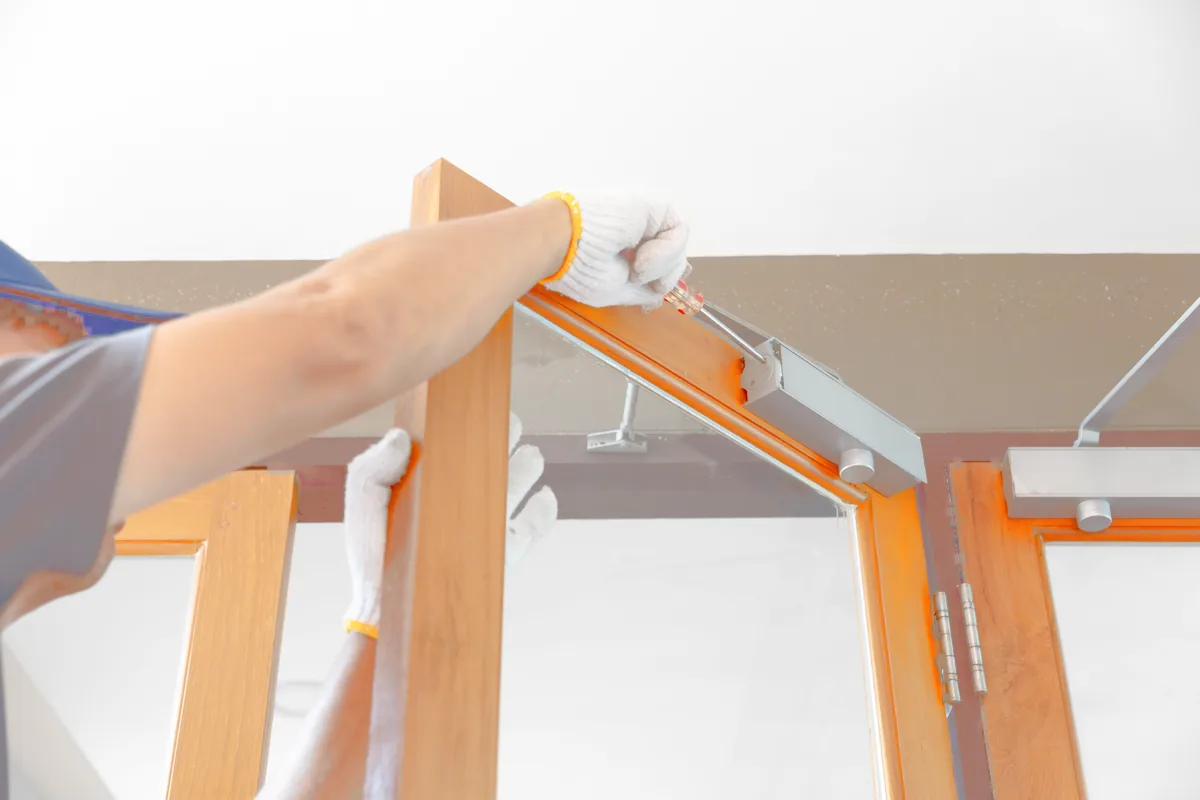
Door closer adjustment in Atlanta: the short answer
Door closer adjustment in Atlanta means setting the valves and spring of a hydraulic closer so a commercial door closes at the right speed and latches. Most commercial hydraulic closers let you adjust a few settings, and each controls a different part of the swing.
On LCN and Falcon closers, Allegion lists three regulating valves (back check, main speed and latch speed) and a separate spring adjustment. Main speed covers the swing from wide open to the last 15 degrees or so, latch speed covers the last 15 degrees or so, and clockwise on a valve makes that part slower. Valves are turned in small steps with the door tested between turns.
Door closer adjustment in Atlanta also checks the door itself, because a closer cannot fix a binding hinge, a rubbing frame or a latch that drags on the strike. A closer that will not hold its settings or shows oil is worn, and the next step is replacement (see leaking door closer repair and door closer replacement). Settings for accessibility are covered under ADA door closer compliance.
Door closer adjustment in Atlanta: quick facts and sources
Minimum time for the closer to move the door from 90 to 12 degrees: 2010 ADA Standards, section 404.2.8.1.
2010 ADA Standards, 404.2.8.1The closing-time sweep ends 12 degrees from the latch, measured from 90 degrees open: 2010 ADA Standards, section 404.2.8.1.
2010 ADA Standards, 404.2.8.1Maximum force to open an interior hinged door: 2010 ADA Standards, section 404.2.9.
2010 ADA Standards, 404.2.9- Regulating valves
- LCN and Falcon closers have three regulating valves (back check, main speed, latch speed) and a spring adjustment, and closers with a delay feature have a fourth valve. Allegion: how to adjust a door closer
- Valve direction
- Clockwise on a valve makes that part of the swing slower, and clockwise on the spring adjustment gives more closing power and makes the door harder to open. Allegion: how to adjust a door closer
- Delayed action
- Allegion lists delayed action of up to approximately 50 seconds on closers that have the feature. Allegion: how to adjust a door closer
- Adjustable settings
- On the dormakaba TS 83 the closing force, the latching action and the backcheck are all adjustable, so one body covers several door weights. dormakaba TS 83 data sheet
- ADA closing time
- The 5 second closing time in 404.2.8.1 is the sweep from 90 degrees open to 12 degrees from the latch, which the main speed valve sets. 2010 ADA Standards, section 404
How a door closer adjustment call in Atlanta works
Call and say which part of the swing is wrong
Say whether the door slams from wide open, crashes at the latch, stalls short of the latch or is hard to open.
Find the valve for that part of the swing
Sweep, latch and backcheck each control a different part of the swing, and spring power sets the overall pull.
Adjust in small steps and test the door
Valves are turned a little at a time, the door is tested between turns, and hinges and latch are checked.
How much does door closer adjustment cost in Atlanta?
How much door closer adjustment costs in Atlanta depends on the door and the closer, so this page gives no figures. The factors are:
- Number of doors and closers. Each closer is set and tested on its own door.
- Closer model. Which valves and spring adjustments the model has.
- Door condition. Hinges, frame rub and the latch and strike alignment.
- Access. Door type and the height and position of the closer.
- Accessibility targets. Measuring opening force and closing time takes a force gauge and a stopwatch.
- Adjust or replace. A closer that will not hold settings is replaced.
For a figure on your door, call for a quote at (470) 256-0441.
Slamming or slow door? Call now.
Say which part of the swing is wrong, and door closer adjustment in Atlanta starts there.
What can be adjusted on a door closer
Most commercial hydraulic closers let you adjust a few settings. Each one controls a different part of the door's swing, so the first step is working out which part of the swing is wrong.
| Adjustment | Controls | Typical symptom when wrong |
|---|---|---|
| Sweep speed (main closing speed) | How fast the door closes from wide open down to the last 15 degrees or so before the latch | Door slams or takes too long to close |
| Latch speed | How fast the last 15 degrees or so of closing goes | Door crashes into the latch or stops short |
| Backcheck | Resistance as the door is opened wide | Door swings into the wall or a user pushes the closer too hard |
| Delayed action (on some models) | Delays the closing swing for an adjustable time, up to about 50 seconds on LCN delayed-action closers | Door closes before a person or cart can pass |
| Spring power (on adjustable models) | How hard the closer pulls the door shut | Door too heavy to open or too weak to latch |
Slamming, slow and not latching
| Door behavior | Usual adjustment | Also check |
|---|---|---|
| Slams in the last few inches | Slow the latch speed | Latch bolt and strike alignment |
| Slams from wide open | Slow the sweep speed | Backcheck, door stop, wind or air pressure |
| Closes slowly and stalls before the latch | Speed up the sweep and latch speed | Hinge drag, rubbing frame, weather stripping |
| Comes to rest an inch or two open | Raise spring power or speed up latch | Latch dragging on the strike |
| Hard to open | Reduce spring power | Closer size, wind or air-pressure differences |
Valves are normally turned in small steps, with the door tested between turns. Allegion's adjustment guide for LCN closers lists three regulating valves (back check, main speed and latch speed) and a separate spring adjustment, each reached with a small hex key. Never force a valve past its stop.
Check the door before the closer
A closer cannot fix a door that is fighting it. Before and after adjusting, the technician checks that the hinges are tight and not binding, the door is not rubbing the frame or floor, and the latch is catching cleanly. A door that is out of square can look like a bad closer when it is not.
Seasonal and building effects
Closer fluid is chosen to limit temperature effects. LCN says the all-weather fluid in its overhead concealed closers eliminates seasonal adjustments, and dormakaba says the closing speed of the TS 83 is virtually unaffected by temperature changes. Older or lower-grade closers can still behave differently in heat and cold. Doors on the outside of a building can also be pushed or pulled by wind and by HVAC air pressure, and Allegion notes that back check is what slows a door thrown open or caught by wind. If the door only misbehaves at certain times, mention when it happens on the call.
What door closer adjustment in Atlanta includes, and what to have ready
The job includes
- Checking hinges, frame rub, floor clearance and latch alignment before touching a valve.
- Setting sweep speed, latch speed and backcheck in small steps, testing between turns.
- Raising or lowering spring power on adjustable models and checking the door still latches.
- Reporting a closer that will not hold its settings or shows oil, for replacement.
Have ready when you call
- Which part of the swing is wrong: wide open, the last few inches or the whole swing.
- Whether it happens all the time or only at certain times, such as wind or air-pressure changes.
- Closer brand and size if readable.
- Whether the door is exterior, fire-rated or on an accessible route.
Door closer adjustment in Atlanta: Georgia rules, permits and inspection
Accessible routes: the ADA numbers
Door closer adjustment in Atlanta on an accessible route targets the 2010 ADA Standards: at least 5 seconds from 90 degrees open to 12 degrees from the latch (404.2.8.1) and 5 pounds maximum opening force on interior hinged doors (404.2.9). 2010 ADA Standards, section 404
Fire-rated doors
On a fire-rated door the adjustment must leave the door closing completely from full open and latching, which NFPA 80 section 5.2.4.2 lists as a minimum check, and Georgia's Rule 120-3-3-.04 adopts NFPA 80, 2022 Edition. NFPA 80, section 5.2 Georgia Rule 120-3-3-.04
Easier opening versus latching
Lowering spring power for easier opening can leave a door short of the latch, so the technician tests both, and the authority having jurisdiction decides what applies. Call to confirm for your door.
Why call this number for door closer adjustment in Atlanta
Atlanta only
This site covers door closers in Atlanta, Georgia and no other city.
Small steps, tested
Valves are turned a little at a time and the door is tested between turns.
Cited, not guessed
Every code number on this page links to the ADA Standards, NFPA 80, Georgia's rule or a manufacturer document.
One call, no forms
The phone is the only way in: call the number on this page and describe the door.
Standards and primary sources behind this page
- Allegion: how to adjust a door closerAllegion (LCN)
- LCN concealed closer guideAllegion (LCN), hosted by The Builder's Supply
- dormakaba TS 83 data sheetdormakaba (formerly Dorma)
- 2010 ADA Standards, section 404U.S. Department of Justice (ada.gov)
- NFPA 80, section 5.2National Fire Protection Association
- Georgia Rule 120-3-3-.04Georgia Office of Commissioner of Insurance and Safety Fire (OCI)
Door closer adjustment in Atlanta: common questions
Which way do I turn the valves to slow a door down?
Door closer adjustment in Atlanta starts with knowing which valve slows which part of the swing. On LCN closers, Allegion says clockwise on the main speed valve closes the door slower and clockwise on the latch speed valve latches it slower and more gently. Other makes can differ, so check the markings or instructions on your closer. Turn in small steps and test the door each time.
Why does my door close fast, then crash at the end?
A commercial door in Atlanta that closes fast and then crashes at the end needs a door closer adjustment at the latch valve. The latch speed is probably set too fast. That is the valve that controls the final few inches before the door latches.
Can adjusting a closer fix a door that never latches?
Door closer adjustment in Atlanta can often fix a door that never latches, by raising the latch speed or the spring power. If the door still stops short, the cause is usually a hinge, a rubbing frame or a latch that is out of line.
Why did my adjusted closer drift back after a few weeks?
A commercial door closer in Atlanta that drifts back after adjustment is usually worn, low on fluid or has a loose valve. Check for oil first. Repeated re-adjusting is a sign it is time for replacement.
My door is hard to open but it has to latch. What do I do?
Door closer adjustment in Atlanta for a door that must be easy to open and still latch is a spring-power and sizing problem. Lowering the spring power can help, but a closer sized too large for the door may need to be replaced with a smaller one. See the ADA page for opening force.
More door closer repair in Atlanta
- Door closer repairSymptoms, closer types and what to have ready
- Surface-mounted closersBody and arm on the door or frame
- Concealed overhead closersCloser hidden in the door or frame head
- Floor closersFloor spring under glass and heavy doors
- Leaking closersOil on the closer, door or floor
- ADA closer compliance5 lbf opening force and 5 second closing
- Fire door closersSelf-closing and latching fire doors
- Closer replacementWhen to replace, sizing and brands
Sources for door closer adjustment in Atlanta
- Allegion knowledge base: How do you adjust a door closer? (LCN and Falcon closers)Allegion (LCN) · manufacturer. Read 2026-11-13.
- LCN Concealed Closer Series product selection guide (2010, 2030, 3030, 3130, 5010, 5030, 6030 series)Allegion (LCN), hosted by The Builder's Supply · manufacturer. Read 2026-11-13.
- dormakaba TS 83 door closer data sheetdormakaba (formerly Dorma) · manufacturer. Downloaded and read 2026-11-13: closing force adjustable (EN 3-6), adjustable latching action, backcheck.
- 2010 ADA Standards for Accessible Design, sections 404.2.7, 404.2.8, 404.2.9 and 309.4U.S. Department of Justice (ada.gov) · primary. Text read directly from the ada.gov page on 2026-11-13 (saved copy: sources/ada2010.txt).
- NFPA 80, Standard for Fire Doors and Other Opening Protectives, section 5.2 (inspection and testing: 5.2.1 and 5.2.4.2)National Fire Protection Association · primary publication page; full code text is behind NFPA's login. NFPA's own text could not be opened without an account. The wording below was confirmed from two published quotations: the NFPA 80 (2010) highlights sheet reproduced by Deltrex USA and Life Safety Services' article quoting sections 5.2.1 and 5.2.4.2. Item numbers inside 5.2.4.2 differ between editions, so only the section number is cited.
- Georgia Rule 120-3-3-.04, State Minimum Fire Safety Standards with Modifications (adopts NFPA 80, 2022 Edition with no modifications, and NFPA 101, 2024 Edition with modifications, including 7.2.1.8.2.1 on spring hinges and self-closing devices) (also official rule text)Georgia Office of Commissioner of Insurance and Safety Fire (OCI) · primary. Read the OCI PDF (dated Nov 5, 2025) on 2026-11-13: item (58) NFPA 80, 2022 Edition, No modifications; item (72) NFPA 101, 2024 Edition; Chapter 7 modifications add 7.2.1.4.1(8) and 7.2.1.8.2.1. Rules change, so confirm current adoption with the AHJ.
Need door closer adjustment in Atlanta?
Atlanta only. Call, no forms: describe the door and what it does, and talk through door closer adjustment in Atlanta, GA.
Still have questions? Call (470) 256-0441 and ask.