
Surface-Mounted Door Closer Repair in Atlanta
Surface-mounted door closer repair in Atlanta fixes bent arms, loose bodies and slamming or slow commercial doors on LCN, Norton and dormakaba closers.
Direct line (470) 256-0441
- Atlanta only
- Call, no forms
- Cites the 2010 ADA Standards and NFPA 80
Surface-mounted door closer repair in Atlanta: the short answer
Surface-mounted door closer repair in Atlanta covers the most common commercial closer: a metal body fixed to the door or the frame, with an arm that links it to the other side. The spring in the body pulls the door shut and hydraulic fluid slows the movement through valves that set closing speed and latch speed.
A surface-mounted closer usually fails in one of three ways: the arm bends or loosens, the mounting screws strip out of the door or frame, or the seal leaks and the closer loses control of the door. A bent arm is replaced rather than straightened, a leak means a new closer (see leaking door closer repair), and slamming or slow doors are mostly settings (see door closer adjustment).
Surface-mounted closers on Atlanta commercial doors are often LCN, Norton or dormakaba models whose published data lists an adjustable spring size or closing force, so one body can suit a lighter or heavier door. Sizing the closer to the door width and material is part of the repair, and describing the door on the call is the quickest way to start.
Surface-mounted door closer repair in Atlanta: quick facts and sources
Minimum time for the closer to move the door from 90 to 12 degrees: 2010 ADA Standards, section 404.2.8.1.
2010 ADA Standards, 404.2.8.1The closing-time sweep ends 12 degrees from the latch, measured from 90 degrees open: 2010 ADA Standards, section 404.2.8.1.
2010 ADA Standards, 404.2.8.1Maximum force to open an interior hinged door: 2010 ADA Standards, section 404.2.9.
2010 ADA Standards, 404.2.9- Spring size
- The LCN 4040XP and Norton 7500 closers are ANSI/BHMA A156.4 Grade 1 with an adjustable spring size or power range of 1 to 6. LCN 4040XP cut sheet
- Mounting positions
- The LCN 4040XP cut sheet lists hinge (pull) side, top jamb (push side) and parallel arm (push side) mounting. LCN 4040XP cut sheet
- Closing force
- The dormakaba TS 83 lists adjustable closing force (EN 3 to 6), adjustable latching action and a backcheck. dormakaba TS 83 data sheet
- Regulating valves
- On LCN closers the back check, main speed and latch speed valves each control one part of the swing, and clockwise makes that part slower. Allegion: how to adjust a door closer
- Seal failure
- A fluid film on the body points to seal failure, and Allegion says LCN closer fluid must not be refilled in the field. Allegion: LCN closer is leaking
How a surface-mounted door closer repair call in Atlanta works
Call and describe the door
Say where the door is, what it does and which side the closer sits on; a phone photo of the closer helps.
Identify the arm and the mounting
Regular arm, top jamb or parallel arm decides which parts the repair needs.
Re-secure, adjust or replace
Loose screws and arms are re-secured or replaced, valves are tuned in small steps with the door tested between turns, and a leaking body is replaced.
How much does surface-mounted door closer repair cost in Atlanta?
How much surface-mounted door closer repair costs in Atlanta depends on what is wrong and which closer is on the door, so this page gives no figures. The factors are:
- Repair or replace. Re-securing a body or arm is a short job; a leaking or cracked closer is replaced.
- Series and size. Spring size runs 1 to 6 on LCN and Norton lines, and a wider or heavier door needs more.
- Arm style. Regular arm, top jamb or parallel arm needs different parts.
- Door and mounting condition. Stripped screws in a door core need a proper fix, such as through-bolts.
- Rating and exterior use. Fire-rated and exterior doors need a closer that suits the opening.
- Finish and brand. Silver, dark bronze and other finishes to match the hardware.
For a figure on your door, call for a quote at (470) 256-0441.
Bent arm or loose closer body? Call now.
Describe the closer and the door, and surface-mounted door closer repair in Atlanta starts with that call.
How a surface-mounted closer works
A surface-mounted closer is the most common commercial closer: a metal body on the door or the frame, and a metal arm that links the body to the other side. When the door opens, the spring winds up inside the body. When the door is released, the spring pushes back, and hydraulic fluid in the body slows that movement so the door closes in a controlled way.
That fluid passes through small valves. Those valves set the closing speed, the latch speed and, on many models, the speed at the very end of the opening swing.
Surface-mounted closer mounting styles
| Mounting | Body location | Arm style | What often goes wrong |
|---|---|---|---|
| Regular arm (hinge or pull side) | On the door, on the side the door opens toward | Two-part arm angled to the frame | Arm bent by over-opening, loose elbow, stripped screws |
| Top jamb (push side) | On the frame head, on the side the door opens away from | Arm reaches down to the door | Bracket loosens in the frame, arm shoe wear |
| Parallel arm (push side) | On the door, on the side the door opens away from | Arm folds parallel to the door | Wrong arm for the door swing, arm screws loosening |
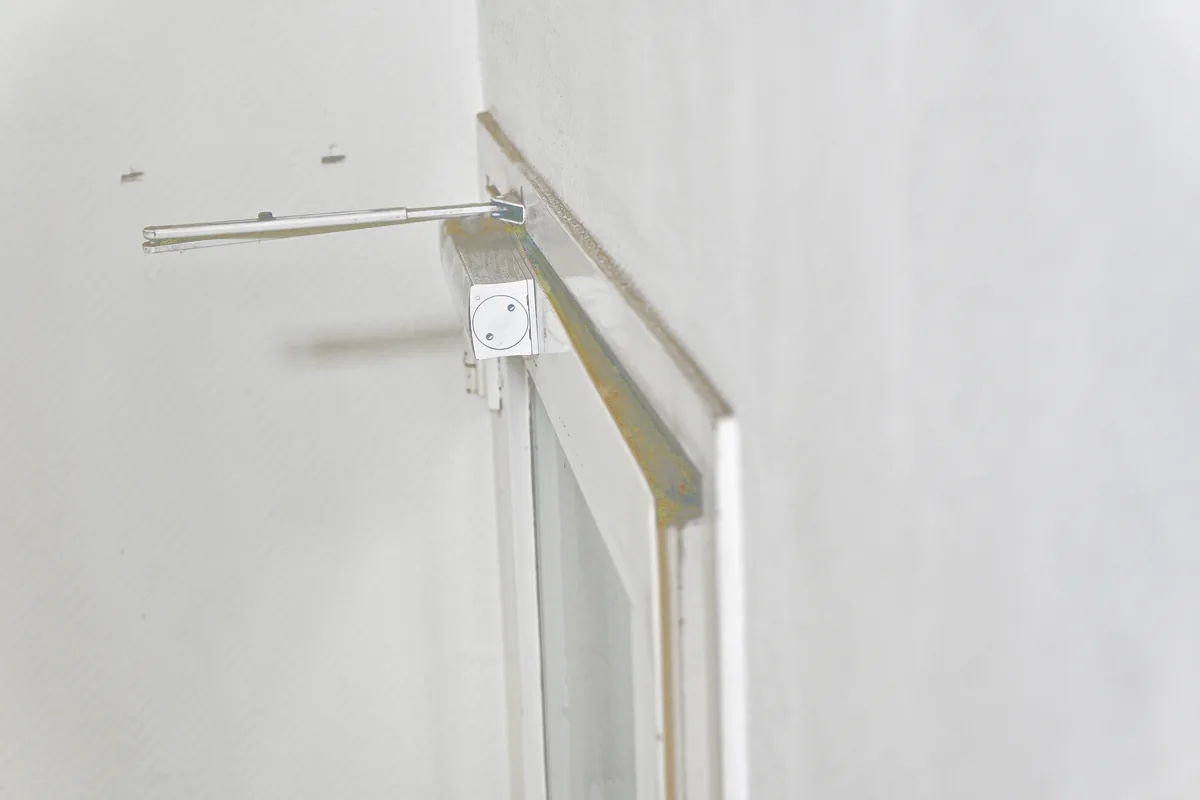
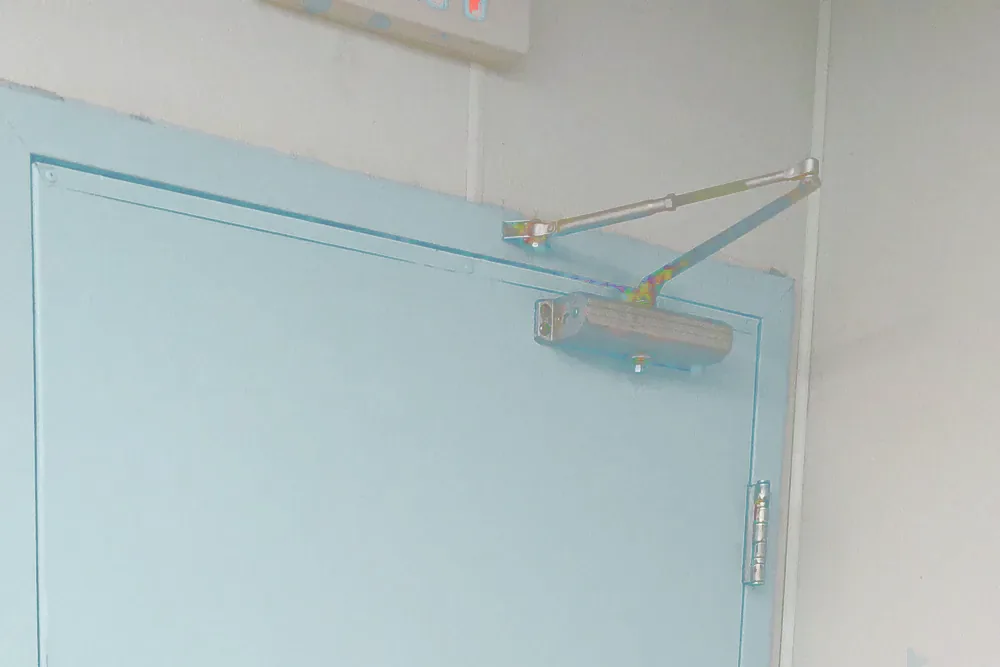
The photo at the top of this page shows a closer on the top rail of a framed glass door. The one below shows a regular-arm closer on a painted metal door: the body sits on the door face and the two-part arm angles up to the frame.
Surface closer problems and fixes
| Symptom | Likely cause | Typical fix |
|---|---|---|
| Door slams | Sweep valve open too far, or fluid low | Adjust valves; replace if oil is leaking |
| Door will not latch | Latch speed too slow, or spring too weak for the door | Adjust latch valve and spring power |
| Arm hanging or loose | Loose elbow screw or stripped mounting | Re-secure, replace the arm, re-set the hardware |
| Body rattles on the door | Loose or stripped mounting screws | Re-drill, use through-bolts where the door allows |
| Door will not stay open or drifts back | Hold-open or backcheck setting, or worn closer | Adjust or replace |
| Fluid on the body | Seal failure | Replace the closer |
Common brands and sizes
Surface closers on commercial doors are often LCN, Norton or dormakaba (Dorma) models. The LCN 4040XP and Norton 7500 lists give an adjustable spring size from 1 to 6, and the dormakaba TS 83 an adjustable closing force, so one closer body can be set to suit a lighter or heavier door. Sized correctly, the closer closes the door without making it hard to open. Tell the technician the door width and material so the closer can be sized to match.
What surface-mounted door closer repair in Atlanta includes, and what to have ready
The job includes
- Re-securing the closer body, bracket and arm, with through-bolts where the door allows.
- Replacing a bent arm, shoe or elbow and re-setting the hardware.
- Tuning the sweep, latch and backcheck valves, then testing the door.
- Replacing the closer when oil shows on the body or the door.
Have ready when you call
- Door width and material: hollow metal, aluminum and glass, or wood.
- Which side the closer sits on and whether the arm is angled or folded flat against the door.
- Brand and model on the cover, or a phone photo.
- Whether the door is fire-rated: look for a label on the door edge or frame.
Surface-mounted door closer repair in Atlanta: Georgia rules, permits and inspection
Surface-mounted door closer repair in Atlanta has to leave the door able to close and latch: on a fire-rated door, NFPA 80 section 5.2.4.2 lists the self-closing device and the latching hardware among the minimum items to check. NFPA 80, section 5.2
On a door that is part of an accessible route, 2010 ADA Standards 404.2.9 limits opening force on interior hinged doors to 5 pounds, so closer power is set no stronger than the door needs. 2010 ADA Standards, section 404
Georgia's Rule 120-3-3-.04 adopts NFPA 80, 2022 Edition. The authority having jurisdiction decides what applies to your opening, so call to confirm for your door. Georgia Rule 120-3-3-.04
Why call this number for surface-mounted door closer repair in Atlanta
Atlanta only
This site covers door closers in Atlanta, Georgia and no other city.
Bodies and arms
This page is about surface-mounted closers; concealed and floor units have their own pages.
Cited, not guessed
Every code number on this page links to the ADA Standards, NFPA 80, Georgia's rule or a manufacturer document.
One call, no forms
The phone is the only way in: call the number on this page and describe the door.
Standards and primary sources behind this page
- LCN 4040XP cut sheetAllegion (LCN)
- Norton 7500 brochureASSA ABLOY (Norton)
- dormakaba TS 83 data sheetdormakaba (formerly Dorma)
- Allegion: how to adjust a door closerAllegion (LCN)
- Allegion: LCN closer is leakingAllegion (LCN)
- NFPA 80, section 5.2National Fire Protection Association
- 2010 ADA Standards, section 404U.S. Department of Justice (ada.gov)
- Georgia Rule 120-3-3-.04Georgia Office of Commissioner of Insurance and Safety Fire (OCI)
Surface-mounted door closer repair in Atlanta: common questions
What is the difference between a regular arm and a parallel arm closer?
Surface-mounted door closer repair in Atlanta covers both regular arm and parallel arm closers. A regular arm closer sits on the door on the side it opens toward and has an angled two-part arm. A parallel arm closer sits on the opposite side with the arm folded flat against the door. Both are surface-mounted and both close the door the same way.
My closer arm is bent. Can it be straightened?
A bent arm on a surface-mounted closer in Atlanta should be replaced, not straightened. A bent arm puts uneven force on the closer body and shortens its life. Find out why the door is over-opening, since a door stop or a backcheck setting may be missing.
Why does my door close fine but not latch?
A surface-mounted door closer in Atlanta that closes the door but leaves it unlatched usually has a latch-speed or spring problem. Usually the latch speed is set too slow, the spring is too weak for the door, or the latch bolt is dragging on the strike. Adjusting the latch valve and checking the latch usually fixes it.
Can I tighten loose mounting screws myself?
Loose mounting screws on a surface-mounted closer in Atlanta are a safety issue because the closer can come off under spring tension. If the screws just spin, the door core is stripped and needs a proper fix. Call so it can be done right.
Does the repair take a long time?
Surface-mounted door closer repair in Atlanta is usually a short visit for tuning or re-securing, and longer when the closer is replaced. Call and describe the door and the closer to get an idea.
More door closer repair in Atlanta
- Door closer repairSymptoms, closer types and what to have ready
- Concealed overhead closersCloser hidden in the door or frame head
- Floor closersFloor spring under glass and heavy doors
- Closer adjustmentSlamming, slow and non-latching doors
- Leaking closersOil on the closer, door or floor
- ADA closer compliance5 lbf opening force and 5 second closing
- Fire door closersSelf-closing and latching fire doors
- Closer replacementWhen to replace, sizing and brands
Sources for surface-mounted door closer repair in Atlanta
- LCN 4040XP Series cut sheetAllegion (LCN) · manufacturer. Downloaded and read 2026-11-13.
- Norton 7500 Series closer brochure (Yale Security / ASSA ABLOY)ASSA ABLOY (Norton) · manufacturer. Downloaded and read 2026-11-13: ANSI/BHMA A156.4 Grade 1; multi-sized power range 1 through 6; back check and regulating valves.
- dormakaba TS 83 door closer data sheetdormakaba (formerly Dorma) · manufacturer. Downloaded and read 2026-11-13: closing force adjustable (EN 3-6), adjustable latching action, backcheck.
- Allegion knowledge base: How do you adjust a door closer? (LCN and Falcon closers)Allegion (LCN) · manufacturer. Read 2026-11-13.
- Allegion knowledge base: LCN closer is leakingAllegion (LCN) · manufacturer. Read 2026-11-13: 'The fluid in an LCN closer must not be refilled in the field.'
- NFPA 80, Standard for Fire Doors and Other Opening Protectives, section 5.2 (inspection and testing: 5.2.1 and 5.2.4.2)National Fire Protection Association · primary publication page; full code text is behind NFPA's login. NFPA's own text could not be opened without an account. The wording below was confirmed from two published quotations: the NFPA 80 (2010) highlights sheet reproduced by Deltrex USA and Life Safety Services' article quoting sections 5.2.1 and 5.2.4.2. Item numbers inside 5.2.4.2 differ between editions, so only the section number is cited.
- 2010 ADA Standards for Accessible Design, sections 404.2.7, 404.2.8, 404.2.9 and 309.4U.S. Department of Justice (ada.gov) · primary. Text read directly from the ada.gov page on 2026-11-13 (saved copy: sources/ada2010.txt).
- Georgia Rule 120-3-3-.04, State Minimum Fire Safety Standards with Modifications (adopts NFPA 80, 2022 Edition with no modifications, and NFPA 101, 2024 Edition with modifications, including 7.2.1.8.2.1 on spring hinges and self-closing devices) (also official rule text)Georgia Office of Commissioner of Insurance and Safety Fire (OCI) · primary. Read the OCI PDF (dated Nov 5, 2025) on 2026-11-13: item (58) NFPA 80, 2022 Edition, No modifications; item (72) NFPA 101, 2024 Edition; Chapter 7 modifications add 7.2.1.4.1(8) and 7.2.1.8.2.1. Rules change, so confirm current adoption with the AHJ.
Need surface-mounted door closer repair in Atlanta?
Atlanta only. Call, no forms: describe the door and what it does, and talk through surface-mounted door closer repair in Atlanta, GA.
Still have questions? Call (470) 256-0441 and ask.